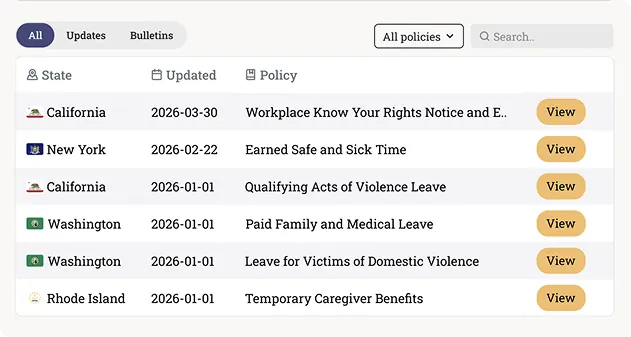
Download a detailed employee handbook developed by U.S. labor attorneys. Includes federal and state policies, along with ongoing updates and e-signatures. Trusted by 25,000+ companies.
No credit card required.
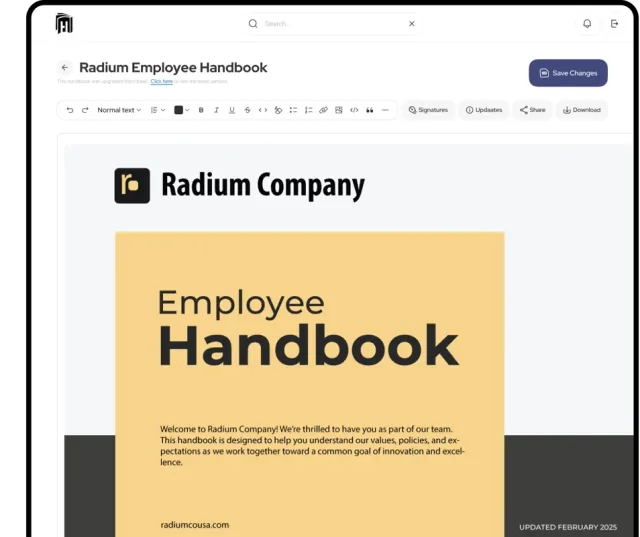
Make an employee handbook and save it as an editable Word document. You can create a basic handbook or comprehensive handbook.

Federal, state, and local policies change throughout the year. It can be difficult to track new requirements for employees. Your dashboard only shows you updates that are relevant to your company. A dashboard with policy updates helps you keep your handbook updated and compliant.
Get started
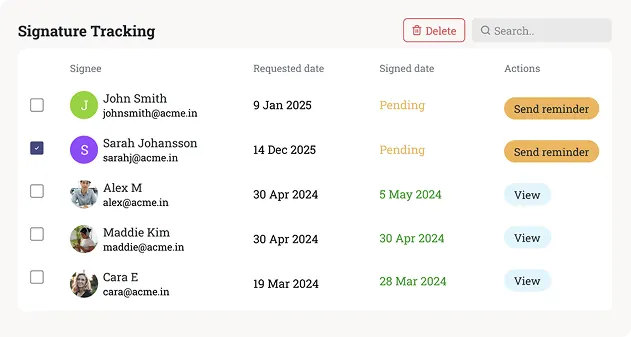
Each employee needs to sign their employee handbook. Most companies update their handbook 2-3 times per year and this can make gathering signatures difficult. Simplify signature capture by emailing your employees an electronic signature request for your handbook.
Get started
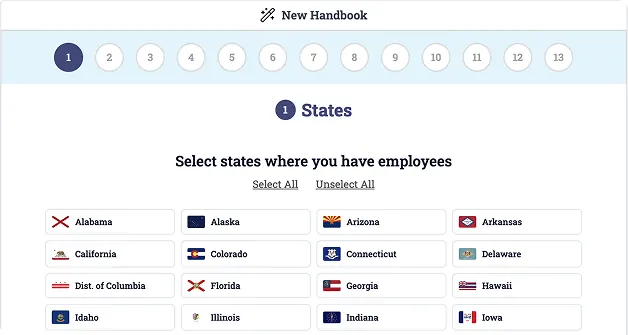
Employers must provide federal, state, and local policies to ensure employees are informed about their rights and workplace expectations, fostering a compliant and transparent workplace. California, Illinois, Minnesota, Florida, Maryland, New York, Pennsylvania, Washington, and others also have city-level policies.
Get started
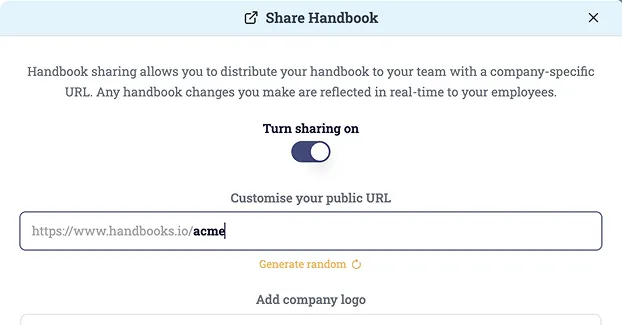
Your team needs access to the most recent version of the employee handbook. You can turn on handbook sharing and provide a company-specific link where your employees can always access the latest version of the handbook. When you make changes to your handbook, they are immediately available to your team.
Get startedThe easiest way to get a free, editable employee handbook.
Ideal for small teams operating in a single state, with up to 10 employees.
Subscribe for added benefits:
Everything in one-time purchase, and:
Perfect for teams operating in 2-5 states, with up to 50 employees.
Subscribe for added benefits:
Everything in one-time purchase, and:
Designed for full U.S. coverage across all states with unlimited employees.
Subscribe for added benefits:
Everything in one-time purchase, and:
We'll update your handbook with the latest federal, state, and local policies. You also get ongoing updates and powerful tools.
We review your handbook and update or add core federal, state, and local policies.
We’ll send you an updated version of your handbook that shows you the changes we’ve made.
One year of ongoing updates to federal, state, and local policies is included. You can add these policies from your dashboard.
You get a live link to your handbook that you can share with employees, Spanish translation, and much more. Download your handbook as a Word document or PDF at any time.


We can do it for you. Our team of HR professionals will update core federal, state, and local policies for $899.
State-specific policies are required for every state where you have employees. Each state has its own required policies.
Many cities and counties have specific protections, benefits, and rules for employees in those locations.
Click on a state to learn more about policies and recommendations.
Stay in compliance with the latest updates for your company, including state and city-specific policies. Get started by creating a new handbook or letting us update an existing handbook for you.
Employers using AI in hiring or other employment decisions should clarify that their equal-employment policies apply to automated decisions. Public Act 26-15 provides that using automated technology is not a defense to discrimination claims.
Effective October 1, the Immigrant Worker Protection Act - Chapter 49.97 RCW requires employers to post the state notice and notify workers and authorized representatives within five business days of a federal I-9 inspection notice. Affected workers must also receive timely inspection-result notices; retaliation is prohibited.
Effective October 1, Public Act 26-12 requires reasonable lactation or breastfeeding breaks in addition to scheduled breaks. Employers must also provide disability-accommodation notices at hiring, within 10 days of a disability disclosure, and to existing employees within 120 days of October 1.
Effective October 1, Public Act 26-12 requires wage ranges and general benefits descriptions in public and internal job advertisements.
Effective October 1, Trey’s Law - SB 30 makes confidentiality provisions unenforceable when they prohibit disclosure of sexual abuse or related facts. Employers should review employment, nondisclosure, and settlement agreements entered into or amended on or after that date.
Effective October 1, the Maryland Worker Freedom Act — Chapter 221 protects employees and applicants who decline employer-sponsored meetings communicating political or religious opinions, subject to statutory exceptions. Employers should update meeting and non-retaliation policies and distribute the state notice when available.
Stay in compliance with the latest updates for your company, including state and city-specific policies. Get started by creating a new handbook or letting us update an existing handbook for you.
Effective September 30, Florida’s minimum wage increases to $15 per hour and the tipped cash wage becomes $11.98 when the full tip credit is used.
Effective September 18, Chapter 618 establishes hospital security requirements; hospitals and nursing homes must establish broader workplace-violence programs by September 18, 2027.
The PROTECT Act requires employers to notify every employee within 48 hours of an ICE I-9 or employment-record inspection notice.
Effective September 12, SB 1126 prohibits schools from preventing employees, contractors, or volunteers from speaking with DCS investigators.
Effective September 12, HB 2663 protects leave taken under military orders for active duty or training. Employers should broaden military-leave policies accordingly.
Stay in compliance with the latest updates for your company, including state and city-specific policies. Get started by creating a new handbook or letting us update an existing handbook for you.
HB 26-1045, effective August 12, 2026, amends the Colorado Anti-Discrimination Act to define "assistance animals" (including service and emotional support animals) and makes blanket bans presumptively discriminatory in housing, requiring individualized assessments. Employers that provide employee housing should update their housing and accommodation practices accordingly.
HB 26-1207, effective August 12, 2026, requires Colorado employers with 100 or more employees that were federal EEO-1 filers as of March 1, 2026, to submit EEO-1 demographic data to the Secretary of State beginning July 1, 2027, even if the federal EEO-1 report is rescinded. Covered employers should preserve their EEO-1 data collection processes regardless of the federal outcome.
Effective August 1, 2026, HB 578 replaces "gender" with "sex" throughout Louisiana statutes and defines sex based on biological sex observed at birth, including under the state employment discrimination law. It imposes no new obligations on private employers, and federal Title VII protections for sexual orientation and gender identity are unchanged.
Effective August 1, 2026, SB 288 prohibits private qualified entities from receiving expunged criminal history record information from the state. Employers that rely on state record sources for screening should ensure hiring and adverse action decisions do not rely on expunged history.
Effective August 1, 2026, Louisiana's Behind the Counter Protection Act (Act 342) creates enhanced criminal penalties for assault and battery against employees serving customers at points of transaction, and allows employers to display state-issued deterrence signage. Retail, food service, and hospitality employers should consider updating workplace violence policies and incident reporting procedures.
On July 22, 2026, the Department of Labor published two opinion letters clarifying that a hybrid employee's mid-day travel between home and the office is noncompensable ordinary commuting, while a field employee's pre-drive client calls and scheduling work can start the compensable workday. Employers with hybrid or field employees should review timekeeping practices against this guidance.
Beginning August 1, 2026, employers must use the 01/20/25 edition of Form I-9 (expiration date 05/31/2027); the prior 08/01/23 edition may no longer be used. Employers using electronic I-9 systems should confirm their systems reflect the current edition.
Stay in compliance with the latest updates for your company, including state and city-specific policies. Get started by creating a new handbook or letting us update an existing handbook for you.
DCWP's final rules, effective July 23, 2026 requires 32 hours of unpaid safe/sick leave available immediately at hire and each January 1 without proration, on top of standard paid leave, plus expanded covered uses. The rules also add six months of post-separation access to leave records and require reinstatement of unused unpaid leave for employees rehired within the same calendar year.
LB 320, effective July 18, 2026, requires hotels and other lodging establishments to display human trafficking awareness posters in English and Spanish, and provides for optional state-developed awareness training. Hospitality employers should confirm posting compliance and consider incorporating the training into onboarding.
The Minnesota Department of Labor and Industry adopted final ESST rules, effective July 6, 2026, addressing the designated accrual year, the 80-hour eligibility threshold, crediting of accruals by the following payday, 80-hour reinstatement for employees rehired within 180 days, employee control over when ESST is used, frontloading, and documentation and misuse. Employers with Minnesota employees should update ESST and PTO policies to reflect the final rules.
Maine's HB 1425, effective July 13th, 2026, strengthens employee drug-testing protections by allowing workers to contest a non-negative result with a legitimate medical explanation, requiring any confirmed positive result to be delivered to the employer through a medical review officer, and obligating employers to give employees 60 days' notice of any change to the drug-testing policy and a copy of the revised policy within 30 days of its effective date.
Beginning July 29, 2026, Maine's LD 2200 makes noncompete agreements with healthcare practitioners unenforceable unless the practitioner holds an ownership interest in the practice, in which case the noncompete takes effect immediately and must include a clause recognizing a patient's right to choose their own healthcare practitioner.
Beginning July 7, 2026, New Hampshire's SB 402 makes noncompete agreements with physician associates unenforceable, though this applies only to agreements signed on or after that date. If an agreement contains such a prohibited noncompete, only the offending portion is voided, and the rest of the agreement remains enforceable so long as it otherwise complies with the law.
Effective July 1, 2026, Connecticut's SB 298 (signed March 3, 2026) requires employers to give employees a written description of any work quota and its consequences by August 1, 2026, with updated notice before any new quota starts. It also bans quotas that block bathroom use, protects workers from discipline for missing unlawful quotas, and requires quota and work-speed records to be kept for three years and shared within 10 days of a request.
Effective July 1, 2026, Tennessee's HB 1034 bars employers from requiring or enforcing noncompete agreements against employees earning less than $70,000 annually. The law also sets out rebuttable presumptions that courts will use to judge whether the time limits in restrictive covenants are reasonable.
Virginia's SB 637, signed by Governor Spanberger on April 13, 2026, strengthens the Human Rights Act by lowering the employer threshold from 15 to 5 employees and extending the discrimination complaint filing deadline from 300 days to two years. Both changes take effect July 1, 2026.
Effective July 1, 2026, HB 4191 encourages employers to offer child care support, which they can provide on-site, through contracted care, subsidies, or flexible spending arrangements.
New Jersey's Assembly Bill 3451 amends the NJFLA to cover employers with 15+ employees (down from 30) and lowers employee eligibility to 3 months of employment and 250 hours worked. The law also strengthens job restoration rights for employees returning from temporary disability or family leave and gives eligible workers the right to choose how they use their accrued sick leave alongside disability benefits.
Stay in compliance with the latest updates for your company, including state and city-specific policies. Get started by creating a new handbook or letting us update an existing handbook for you.
Colorado HB 1283 prohibits employers from requiring employees or applicants to surrender government-issued identification. Employers must provide and retain a written notice of this restriction, in English or the employee’s primary language, with the employee’s acknowledgment.
Effective June 11, employers may be required to pay 1% monthly interest on wage amounts ordered by the Department of Labor & Industries, in addition to applicable penalties. The Department may not order payment of wages or interest for violations occurring more than three years before it received information about the violation.
Effective June 11, 2026, amendments to the state paid family and medical leave program revise how employers may collect employee premium contributions. Employers may deduct up to the full required medical leave premium from employees’ wages, and family leave deductions are adjusted under the new statutory formula.
Effective June 12, 2026, West Virginia law provides that a business’s contributions to a portable benefits plan will not be used to determine whether a worker is an employee or an independent contractor. Portable benefit plans may include third-party health, life, disability, retirement, or similar benefits.
Effective June 11, 2026, employers must notify an employee and their union representative within five business days of receiving notice of a federal I-9 inspection, and provide a copy of the results within five days of receiving them.
Effective June 11, 2026, employers may not require workers or job applicants to undergo microchipping or similar implanted tracking technology as a condition of employment.
Effective June 5, 2026, HB 4111 makes it unlawful to discharge, discriminate, or retaliate against an employee for updating their personal information based on a lawful change to their federal employment authorization documents.
Effective June 1, 2026, the Family Neonatal Intensive Care Leave Act requires employers with 16 or more employees to provide unpaid leave to workers whose child is admitted to a neonatal intensive care unit. Employers with 16 to 50 employees must provide up to 10 days; those with 51 or more must provide up to 20 days.
Stay in compliance with the latest updates for your company, including state and city-specific policies. Get started by creating a new handbook or letting us update an existing handbook for you.
Healthcare providers who decline to take part in certain services on religious or conscience grounds must give their employer advance written notice, report which categories of services they will not provide, and post a notice for patients in their office. Providers are protected from adverse action for these conscience-based refusals. This does not apply to emergency care.
Employers cannot charge applicants or employees for required pre-employment or periodic medical exams, including occupational-health screenings, fitness-for-duty evaluations, employer-required drug screens, hearing tests, and respirator-fit testing. Employers must pay the provider directly, and employees cannot be required to use paid time off or unpaid time to attend a mandatory exam.
Under SB 89, a health care services platform cannot require a covered worker to sign a non-compete agreement, charge a worker a fee for accepting a job with a provider or facility, or stop a worker from using other platforms or taking shifts or jobs elsewhere. (Effective in 2026, the law also no longer treats physicians, advanced practice registered nurses, certified nurse midwives, and physician assistants as covered "health care workers" under these platform rules.)
Under HB 270, most post-employment non-compete agreements with healthcare workers are void, and non-solicitation clauses cannot stop a departing healthcare worker from telling patients where they now work. Confidentiality and trade-secret protections still apply, and agreements signed before the law's effective date remain valid.
Starting May 1, 2026, eligible employees can receive paid leave benefits under Maine's Paid Family and Medical Leave program. Employees may take up to 12 weeks per year of partial wage replacement for their own serious health condition, to care for a family member, to bond with a new child, for military-related needs, or for "safe leave" as a survivor of domestic or sexual violence or stalking.
HB 232 streamlines how employers obtain employment certificates for workers under 18 and clarifies which employers and forms are involved. The existing rules on prohibited occupations and hours of work for minors are unchanged.
Employers with 100 or more employees (including at least one in California) must file their 2025 pay data report with the Civil Rights Department by May 13, 2026, using updated templates that add exemption status, employment type, and total weeks worked. A separate report is required for workers supplied by labor contractors.
Stay in compliance with the latest updates for your company, including state and city-specific policies. Get started by creating a new handbook or letting us update an existing handbook for you.
The Workforce Development Act allows youth apprenticeship programs for students in grades 11 and 12, or anyone age 16 or older. Youth apprentices cannot be assigned to any job that is off-limits to workers under 16 under state or federal law, and hazardous agricultural work requires federal approval. Employers must provide proper training, supervision, and safety equipment, and all work-permit, hours, and recordkeeping rules still apply.
Effective April 1, 2026, S 4928 extends the state's Prevailing Wage Act to private data-center construction projects (those of at least 250 kilowatts capacity or 500 kilowatt-hours of design usage). Workers on these projects are entitled to prevailing wages and fringe benefits.
Hotels in unincorporated LA County must give panic buttons to workers assigned to work alone, have trained staff respond when one is activated, and allow paid time to report violent or threatening guest behavior to law enforcement. Room attendants have limits on their workload and consecutive hours. Starting October 1, 2026, covered hotels must also provide at least six hours of Public Housekeeping Training on workers' rights and protections.
S03072, amends the New York Fair Credit Reporting Act to prohibit employers from requesting or using an applicant's or employee's consumer credit history in hiring, compensation, or other employment decisions. Narrow exemptions apply for roles where credit checks are mandated by law, law enforcement, bonded or security-clearance positions, and high-trust financial roles.
Stay in compliance with the latest updates for your company, including state and city-specific policies. Get started by creating a new handbook or letting us update an existing handbook for you.
Permanent L&I rules effective March 6, 2026 enforce the state's immigration workplace protections law: employers cannot use a worker's or their family's real or perceived immigration status to threaten, coerce, or deter protected activities such as reporting unsafe conditions, requesting owed wages, or filing complaints.
Effective March 19, 2026, House Bill 246 requires non-residential construction contractors, subcontractors, and labor brokers on commercial projects to verify every new hire through E-Verify and immediately terminate anyone who receives a final non-confirmation, with previously verified employees exempt.
Effective March 1, 2026, the minimum wage in the City of Santa Fe and unincorporated Santa Fe County rises to $15.40/hour (from $15.00). The tipped base wage is $4.62/hour in the county and stays at $3.00/hour in the city.
Under the Workplace Know Your Rights Act, employers must give current employees the chance to designate an emergency contact by March 30, 2026, and must collect it from new hires at the time of hire. If an employee is arrested or detained at the worksite, or off-site during work hours where the employer has actual knowledge, the employer must notify that contact.
Stay in compliance with the latest updates for your company, including state and city-specific policies. Get started by creating a new handbook or letting us update an existing handbook for you.
DC requires employers to post the new 2026 Paid Family Leave notice in a conspicuous common area and distribute it to all covered employees by February 1, 2026. The program now provides up to 12 weeks of paid parental, medical, and family leave (up from 8 weeks), plus 2 weeks of prenatal leave, with a maximum weekly benefit of $1,190.
Effective February 1, 2026, COMPS Order #40 and related rules update several Colorado policies. The way sick pay is calculated under the Healthy Families and Workplaces Act changes for salaried, commissioned, and piece-rate employees. The tipped minimum wage is $12.14/hour with a $3.02 tip credit. New whistleblower and anti-retaliation protections apply.
The Workplace Know Your Rights Act requires employers, by February 1, 2026, to give all current employees a standalone written notice, using the Labor Commissioner's official template, covering their rights regarding workers' compensation, immigration inspections, protection from unfair immigration-related practices, organizing, and interactions with law enforcement at work. Employers must also let employees designate an emergency contact by March 30, 2026.
The state of New York has passed the Senate Bill S4070B and Assembly Bill 9452, amending the Trapped at Work Act and banning promissory notes requiring an employee to reimburse the employer for training expenses. The definition of employee under this law has been broadened to cover any individual employed for hire by an employer in all forms of employment.
Effective February 22, 2026, amendments to the Earned Safe and Sick Time Act (ESSTA) give all employees, including new hires, a bank of 32 hours of unpaid safe and sick time at the start of each calendar year. This is in addition to existing paid leave of 40 or 56 hours. Leave can now be used for more reasons, including child care, caregiving, workplace violence, subsistence benefits, housing, and public disasters. Employers must give all current employees an updated Notice of Employee Rights within 14 days of the effective date.
Stay in compliance with the latest updates for your company, including state and city-specific policies. Get started by creating a new handbook or letting us update an existing handbook for you.
Rhode Island has increased Temporary Caregiver Benefits leave length to 8 weeks effective January 1, 2026.
Pittsburgh has updated its Paid Sick Days Act effective January 1, 2026. Leave accruals have increased to 1 hour for every 30 hours worked (previously 1 hour per 35 hours). Employees at companies with 15+ employees may accrue up to 72 hours; smaller companies up to 40 hours.
Oregon has updated its Paid Sick Leave law effective January 1, 2026. The update permits employees to use paid sick leave to donate blood.
New Hampshire has enacted new military leave protections effective January 1, 2026. Employees with a spouse in the military are now protected from discharge or adverse employment actions based on the spouse's involuntary mobilization.
Effective January 1, 2026, New Hampshire employers must provide up to 25 hours of unpaid leave for employees to attend medical appointments related to childbirth, postpartum care, or pediatric appointments within the first year of a child's birth or adoption.
Minnesota has provided updated guidance on meal and rest breaks, effective January 1, 2026. Employers should review and update their break policies accordingly.
Minnesota Paid Family and Medical Leave becomes effective January 1, 2026. It provides paid leave for absences due to serious health conditions affecting the employee or their family, the birth or adoption of a child, for victims of domestic or sexual violence, and active-duty military deployments.
Effective January 1, 2026, the Illinois Employee Blood and Organ Donation Leave Act has been updated to allow part-time employees to take paid leave for blood and organ donation.
The Illinois Military Leave Act has been updated effective January 1, 2026. Employees whose employment is interrupted by military service may now use any accrued paid leave during their service, though they are not required to do so.
Delaware Paid Leave becomes effective January 1, 2026. It provides paid leave for absences due to serious health conditions affecting the employee or their family, the birth or adoption of a child, and active-duty military deployments. Employers should add this new policy to their employee handbook.
Effective January 1, 2026, Colorado has expanded its Family Medical Leave program. Employees with a child receiving care in an inpatient neonatal intensive care unit are now eligible for up to twelve additional weeks of leave during the duration of the care.
Washington's Paid Family and Medical Leave program has been updated effective January 1, 2026. The minimum claim duration has been reduced from 8 to 4 consecutive hours. Job protection requirements have also been updated, reducing the length of service requirement to 180 calendar days.
Effective January 1, 2026, Washington has updated its Leave for Victims of Domestic Violence policy to include "hate crime" as a qualifying reason for leave. Employees who are victims of domestic violence, sexual assault, hate crimes, or stalking may take reasonable time off from work.
California's Paid Sick Leave law has been updated effective January 1, 2026. The update includes new reasons for leave usage, including for victims of a qualifying act of violence. Employers should update their California Paid Sick Leave policy accordingly.
Effective January 1, 2026, California employers must maintain detailed training records. These records must include the employee's name, trainer's name, training date, content, and any certifications or qualifications that resulted from training. Employers must retain these records for at least three years.
Stay in compliance with the latest updates for your company, including state and city-specific policies. Get started by creating a new handbook or letting us update an existing handbook for you.
Employers must post a notice developed by the commissioner of the Minnesota Department of Employment and Economic Development (DEED) in a conspicuous place. Employers must also provide written information regarding the availability of Paid Family and Medical Leave benefits by this date, or within 30 days from the beginning of employment.
Stay in compliance with the latest updates for your company, including state and city-specific policies. Get started by creating a new handbook or letting us update an existing handbook for you.
There are multiple updates across many states and cities that take effect on January 1, 2026. Now is a good time to review your handbook and include any new updates.
California has expanded its pay transparency legislation to include updated requirements for disclosing the “pay scale” to applicants. These updates are effective January 1, 2026.
California has updated protections for victims of domestic violence and their family members. The new rules apply to “qualifying acts of violence” that occurred during prior periods.
Effective January 1, 2026, California employers must maintain detailed training records. These records must include the employee’s name, trainer’s name, training date, subject matter, and any new skills or certifications. Employers must retain these records for at least three years.
Cuyahoga County, Ohio (including Cleveland), has banned discrimination based on natural hairstyles. The CROWN Act, effective November 13, 2025, prohibits discrimination against individuals based on hair texture or style. The local law aligns with a nationwide effort to advance protections for race-based hair discrimination.
By November 1, 2025, Minnesota employers must notify seasonal employees in writing that they are not eligible for Paid Leave benefits. This is a requirement ahead of the new Paid Leave law that takes effect on January 1, 2026.
Stay in compliance with the latest updates for your company, including state and city-specific policies. Get started by creating a new handbook or letting us update an existing handbook for you.
The state’s child labor law now includes lower caps for young workers. Employees under the age of 16 are now capped at 40 hours of work per week, and are prohibited from working between 11:00 pm and 6:00 am on school nights.
The city of Cleveland has passed a new pay transparency law, which is effective October 27, 2025. Companies with 15 or more employees must include salary ranges in job postings. Employers are prohibited from inquiring about a candidate's prior compensation history.
The state now provides protections for volunteer emergency responders for being late or absent from work when connected to their volunteer emergency service.
The state’s new pay transparency and wage disclosure law becomes effective October 29, 2025. Companies with 25 or more employees must include a good-faith pay range for job postings and disclose that range to internal and external applicants.
Penalties for violations of wage and hours rules have increased sharply. Employer fines for a willful violation are now $5,000 and $25,000 for a second willful violation within five years. A second willful violation without a remedy in 60 days is $50,000.
The Employment and Insurance Equality for Service Members Act expands protections for military service members, including leave for family members of service members and upcoming expanded leave under FAMLI.
The state’s Wage Range Transparency law goes into effect on October 1, 2025. The new law requires employers to include the wage range (minimum and maximum) as well as other benefits for internal and external candidates.
Stay in compliance with the latest updates for your company, including state and city-specific policies. Get started by creating a new handbook or letting us update an existing handbook for you.
The Oregon Family Leave Act was updated to clarify that leave to care for a child applies only if the child is under 18 or is an adult dependent who is substantially limited by physical or mental impairment. More details here about Oregon Family Leave Act – Clarified Child Definition.
A new amendment to the Nursing Mothers in the Workplace Act requires employers to provide paid break time (30 minutes per session) to express breast milk for up to one year after birth, unless doing so causes undue hardship. This becomes effective January 1, 2026. Read the full text here about Illinois Paid Lactation Breaks for Nursing Mothers.
The renamed Military Leave Act (formerly the Family Military Leave Act) now requires paid leave for eligible employees on funeral honors details—up to 8 hours/month and 40 hours/year, at regular pay. Effective immediately. Learn more here about Illinois Paid Funeral Honors Leave.
Substantial civil penalties are now effective for violations of the Illinois Human Rights Act. The first penalty can be up to $16,000 per event, and higher for repeat violations. Details available here about Illinois Human Rights Act – New Civil Penalties.
Employees with accrued but unused sick leave must be allowed to carry those hours into subsequent years—though leave use remains capped at 40 hours per year. Read the Maine DOL’s summary here about Maine Earned Paid Leave Rollover Rules.
The state’s new paid sick leave law (Healthy and Sustainable Families and Workplaces Act) becomes effective October 1, 2025. Employers must provide notice to employees by September 15, 2025. Learn more here about Nebraska Healthy and Sustainable Families and Workplaces Act.
Stay in compliance with the latest updates for your company, including state and city-specific policies. Get started by creating a new handbook or letting us update an existing handbook for you.
Employers who misclassify employees are subject to steep fines, effective August 6, 2025. A wilful misclassification may result in a $5,000 fine.
The state's paid sick leave law became effective July 1, 2025, and employers are required to provide notice to all employees no later than August 1, 2025 that they are entitled to paid sick leave. This policy update is available in the handbook.
Employers in the state are no longer required to provide paid sick leave to employees effective August 28, 2025. The law, which went into effect May 1, has been repealed. This policy update is available in the handbook.
The city of Minneapolis added a new anti-discrimination statute based on a person's "justice-impacted status", which includes having "a criminal record or history, including any arrest, charge, conviction, period of incarceration, or past or current probationary status". Additionally, housing status is a protected characteristic as well. This policy update is available in the handbook.
Stay in compliance with the latest updates for your company, including state and city-specific policies. Get started by creating a new handbook or letting us update an existing handbook for you.
Non-compete agreements in Wyoming are significantly limited as of July 1, 2025. These agreements become unenforceable for most employees under the new regulations, with some narrow exceptions.
Effective July 1, 2025, employers in Colorado must obtain consent from employees for collecting or using their biometric data. Employers should evaluate the data they collect on employees, including fingerprints, facial recognition systems, and the use of audio or photographs.
An existing ban on non-compete agreements for low-wage workers has been expanded to include employees subject to the FLSA. Effective July 1, 2025, employees who can earn overtime (i.e., nonexempt employees).
A new law requires that employees who adopt a child be provided with the same benefits as employees having a newborn biological child. An update for this policy is available in your handbook dashboard.
Paid sick leave is required to be provided by most employers in Alaska as of July 1, 2025. Written notice should be provided by July 31, 2025, or as of an employee's date of hire. An update for this policy is available in your handbook dashboard.
A clarification from relevant agencies clarifies that employees in Cook County cannot earn leave while taking leave. An update for this policy is available in your handbook dashboard.
Employers in Los Angeles County are subject to a new Fair Workweek Ordinance (FWWO). Previously, this ordinance only applied to employees in the City of Los Angeles. It applies to retail businesses with 300 or more employees in total. An update for this policy is available in your handbook dashboard.
New accommodations for nursing employees apply to companies with 6 or more employees and are effective July 1, 2025. An update for this policy is available in your handbook dashboard.
Parental and Family Leave has been expanded to include additional reasons leave may be taken (including bereavement, domestic violence, or qualifying military exigency). Vermont Short Term Leave is also expanded to include broader definitions of family member. An update for this policy is available in your handbook dashboard.
Stay in compliance with the latest updates for your company, including state and city-specific policies. Get started by creating a new handbook or letting us update an existing handbook for you.
The state legislature passed a law that aligns the state's health and safety standards with OSHA and prohibits the state agency from enforcing standards that have not been adopted by the federal agency.
Employers with 100 or more employees and federal contractors with 50 or more employees must submit 2024 data related to workforce composition by job category, race/ethnicity, and sex by June 24, 2025.
Effective June 1, companies with 10 or more employees that have employees in New Jersey, do business in the state, must provide required pay transparency disclosures related to wages, benefits, and other compensation.
Stay in compliance with the latest updates for your company, including state and city-specific policies. Get started by creating a new handbook or letting us update an existing handbook for you.
State Bill 1218 was recently signed into law. The legislation prohibits employers in Virginia from enforcing or entering into a non-compete agreement with an employee who earns less than the average wage in the state, which is currently around $76,081 per year. This legislation becomes effective in July 2025.
Employers are required to provide at least 24 consecutive hours of rest to employees each week under the One Day Rest in Seven Act. A recent bill prohibits retaliation against employees for exercising their rights under the act.
The state's minimum wage increase was also upheld. The new $15 minimum wage becomes effective January 1, 2026. The current minimum wage is $13.75/hr.
A voter-approved initiative calling for paid sick leave went into effect on May 1, 2025. Employers are required to provide 1 hour of paid sick leave for every 30 hours worked. The state's Supreme Court upheld the law after challenges.
A new executive order directs federal agencies to cease the use and enforcement of "disparate impact" standards in civil rights investigations, regulations, and enforcement actions. The order argues that evaluating outcomes based on group statistics, rather than direct evidence of intentional discrimination, undermines individual merit, creates unfair advantages or disadvantages.
Stay in compliance with the latest updates for your company, including state and city-specific policies. Get started by creating a new handbook or letting us update an existing handbook for you.
A new heat illness rule has been proposed to protect employees who work in hot conditions indoors or outdoors. It includes acclimatization, training, emergency procedures, and control measures.
Employers must provide notice to their employees by April 15 about the new paid sick leave law that becomes effective on May 1, 2025. The new law provides either 40 or 56 hours of paid sick leave per year, depending on the size of the company.
Stay in compliance with the latest updates for your company, including state and city-specific policies. Get started by creating a new handbook or letting us update an existing handbook for you.
Multiple executive orders have been issued and several are pending court challenges. Ongoing updates will be provided.
The State Department narrowed eligibility for nonimmigrant visa interview waivers, reducing the prior 48-month grace period to just 12 months and limiting waivers to applicants renewing visas in the same category. This change was made in response to an executive order aiming at tightening visa screening. This change affects H-1B visa applicants.
Non-compete agreements are much more difficult to enter into with employees and independent contractors in the state. A recently signed bill goes into effect July 1, 2025, and significantly narrows the exceptions in which a non-compete agreement is allowed.
Retail employers with 10 or more employees will need to adopt a workplace violence prevention policy. Larger employers with 500 or more employees have additional requirements, including installing a silent response button (SRB) or "panic button". The effective date for this has been moved from March 4, 2025 to June 2, 2025.
Stay in compliance with the latest updates for your company, including state and city-specific policies. Get started by creating a new handbook or letting us update an existing handbook for you.
Multiple executive orders have been issued and several are pending court challenges. Ongoing updates will be provided.
The Michigan Earned Sick Time Act becomes effective on February 21, 2025. Employees accrue one hour of paid sick leave for every 30 hours worked. Employees of small businesses (fewer than 10 employees) may use up to 40 hours of leave per year, while companies with 10 or more employees may use up to 72 hours per year.
Stay in compliance with the latest updates for your company, including state and city-specific policies. Get started by creating a new handbook or letting us update an existing handbook for you.
Many private employers who receive state funds may no longer prohibit employees from keeping a firearm in their vehicle at work.
Effective January 1, 2025 applicants may answer in the negative to prior convictions that have been expunged.
Employers must not discriminate against employees or applicants on the basis of family responsibilities. A new law is effective January 1, 2025.
Employers are required to retain pay stub information for at least 3 years and provide it to current or former employees upon request.
Effective January 1, 2025 employers are prohibited from using AI that has a discriminatory effect. Companies are also required to notify employees if they use AI for employment decisions.
Many states had updates that require changes to handbook policies. You are encouraged to subscribe to incorporate the many important changes.
Stay in compliance with the latest updates for your company, including state and city-specific policies. Get started by creating a new handbook or letting us update an existing handbook for you.
Employers with 20 or more employees must provide up to 56 hours of paid sick leave to employees. Companies with 19 or fewer employees must provide up to 40 hours. Nebraska voters approved a ballot initiative which goes into effect on October 1, 2025.
Effective May 1, 2025, Missouri employees will earn paid sick leave. Companies with 15 or more employees earn up to 56 hours, while companies with 14 or fewer employees earn up to 40 hours of paid leave. The state minimum wage was also increased to $15/hour.
Voters also approved a minimum wage increase to $13/hour and restrictions to mandatory employee meetings on religious or political topics.
As a result of Ballot Measure 1, which passed in November, several significant changes are coming, including state-wide paid sick leave. Employees will accrue up to 56 hours of paid leave. The policy goes into effect July 1, 2025.
Effective November 21, 2024, employees can use earned sick time to "address the employee's own physical and mental health needs, and those of their spouse, if the employee or the employee's spouse experiences pregnancy loss or a failed assisted reproduction, adoption or surrogacy."
Stay in compliance with the latest updates for your company, including state and city-specific policies. Get started by creating a new handbook or letting us update an existing handbook for you.
Effective October 1, 2024, companies are required to post wages and descriptions of benefits with all job postings that will be performed at least partly in Maryland.
The Maryland Equal Pay for Equal Work Act was updated to prohibit pay discrimination based on sexual orientation, race, disability, or religious beliefs.
Family Violence Leave has been updated to include victims of sexual assault. Companies with 3 or more employees are required to provide up to 12 days of leave for employees who qualify for leave.
Stay in compliance with the latest updates for your company, including state and city-specific policies. Get started by creating a new handbook or letting us update an existing handbook for you.
Employers are required to maintain health coverage while employees are utilizing an accommodation for pregnancy.
Only workers under 16 years of age are entitled to a meal break when working 5 or more consecutive hours. The previous age required was 18.
Employers are prohibited from requiring employees to attend mandatory "captive audience" meetings concerning union representation. The legislation goes into effect on January 1, 2025.
In House Bill 3773, the Illinois Human Rights Act was amended to protect against discrimination and require transparency regarding the use of AI in companies.
One generic handbook does not work for every business. By providing answers to company-specific questions, you ensure that your handbook is applicable to the work you're doing (and where your employees are located). You can always go back and edit your handbook later.
Your handbook is assembled when all of your company data has been gathered. It takes only a few minutes to create an updated handbook with clear expectations and guidelines for your team.
Edit, share, and collect digital signatures. Export your handbook as a Microsoft Word Document. You should review your handbook with your trusted advisors and make any changes you deem necessary. If you need assistance, we're here to help!

Best practices, guidance and information for companies

Everything you need to know about your new employee handbook.
Although we recommend that you consult with your expert advisors, our hope is that generating your employee handbook is an easy and affordable process. We work hard to deliver thoroughly vetted, clear and concise documents. We believe that a great handbook is foundational for great companies.
There are plenty of reasons you should have a current, well-written employee handbook. Here are a few of our favorites: 1) Set the tone in your workplace 2) Communicate what is expected of employees 3) Ensure your policies are clear and accessible for your team 4) Defend yourself against employee claims 5) Explain your company benefits and what sets you apart.
There are about 20 additional sections included: Welcome Statement, Introductory Period, Performance Reviews, Employment Records, Disciplinary Policy, Employee Conduct and Work Rules, Use of Communication and Computer Systems, Punctuality and Attendance, Confidential Company Information, Solicitation, Conflict of Interest and Business Ethics, Equipment and Property Including Intellectual Property, Health and Safety, Hiring Relatives, Expense Reimbursement, References, Employee Acknowledgements, and State + city-specific policies. All of these sections (and more) are included in the Comprehensive handbook.
The free handbook is a useful, high-quality handbook. The benefit of upgrading to the Comprehensive handbook (either through a one-time payment or subscription) is receiving expanded content and additional policy sections. You also get state and city-specific policies. If you have employees in multiple states and cities, this is an important benefit. Purchasing the subscription option gives you access to ongoing updates + the link-sharing feature. Link sharing allows you to create a company-specific URL to share with your employees. Any time you make an update to the handbook, your entire team will have the current version.
The Handbook Builder process begins with a series of survey questions. Typically, these questions can be answered in less than 5 minutes. The employee handbook is generated immediately after completing the survey. Many of our users are able to complete the entire process in less than 10 minutes.
The Comprehensive handbook includes policies specific to where your employees are located. This is important because the number of state and city-specific policies has increased greatly over the last few years. As more and more companies have moved to remote work, it's not uncommon to have teams spread out over wide geographies. State and city-specific policies are important to help keep employers compliant and aligned on rules and requirements for each locale. State and city policies vary greatly around paid sick time, family and medical leave, and reimbursement of unpaid sick time (as well as many other topics). These state and city-specific policies are included in the Comprehensive handbook.
I really don't have the expertise to put together an employee handbook. This was a great solution.
We just wanted an updated, modern employee handbook for our team. This was perfect.
Our current employee handbook was 15 years old. It was time for an update.


Can’t find the answer you’re looking for? Please chat with our friendly team.