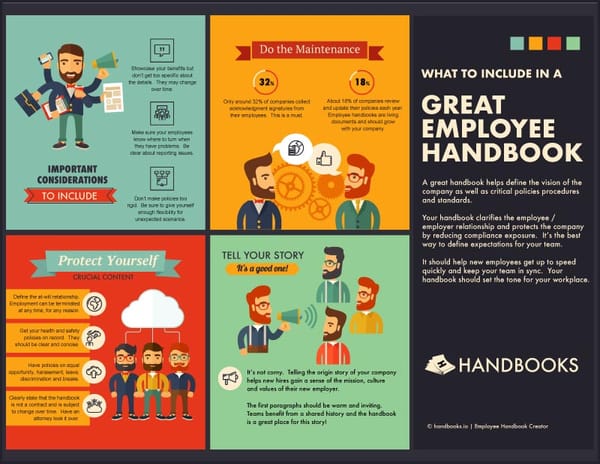

To share this infographic as a PDF, you can use this link.

An employee opens your handbook because they need an answer.
Maybe they want to request time off. Maybe their paycheck looks wrong. Or perhaps they need to report a problem involving the person they would normally ask for help.
In that moment, your company history and mission statement can wait. The employee needs to know what to do next.
A good employee handbook should explain workplace expectations, pay and time off, employee support, reporting procedures and the policies that apply to your workforce. It should also be easy to use without someone from HR translating every paragraph.
So, what should you actually include?
The following employee handbook checklist is a useful starting point. It is not a universal legal checklist: required content depends on your workforce, locations, industry and the laws that cover your business.
1. A brief welcome and a clear point of contact
Start by explaining who the company is, what it does and what employees can expect from working there.
Keep this section short. A welcome message, a few meaningful values and a description of how the company works are usually more helpful than several pages of company history.
Then give employees something practical: contact information.
Who handles payroll questions? Who receives leave requests? Where should someone go if their manager cannot help?
Use a maintained email address or role-based contact where possible. A handbook becomes frustrating very quickly when its only named contact left the company six months ago.
2. Employment basics and the handbook’s purpose
Explain the employment categories your company uses, such as full-time, part-time, temporary, exempt and nonexempt. Make clear which policies apply to which groups.
These labels should reflect actual classifications, not create them. For example, a job title alone does not determine whether an employee is exempt from overtime requirements. Department of Labor guidance.
Also explain the handbook’s purpose and relationship to other employment documents.
At-will language and noncontract disclaimers need jurisdiction-specific review. They should not be copied into every handbook automatically. Montana’s discharge protections, for example, differ from the assumptions behind a standard at-will statement. Montana employment law.
3. Equal opportunity, harassment prevention and reporting concerns
A statement saying “we do not tolerate harassment” is a start. It does not tell an employee how to get help.
Your handbook should explain:
- What conduct the policy addresses.
- How employees can report concerns.
- An alternative reporting contact if their supervisor is involved.
- How the company will respond.
- That retaliation for protected reporting or participation is prohibited.
Avoid promising complete secrecy. Explain that information will be handled discreetly and shared as needed to investigate and respond appropriately. The EEOC’s harassment-policy recommendations provide a useful framework.
Do not require employees to confront the person involved before reporting. Internal reporting procedures should also preserve employees’ rights to contact government agencies.
Check separately for applicable state or local written-policy and training requirements.
4. Pay, working hours and timekeeping
This section should answer the questions employees ask about getting paid.
Include the pay schedule, how working time is recorded, whom to contact about payroll errors, overtime procedures, and applicable meal and rest-break arrangements.
Explain how employees report missed time or work performed outside their usual schedule. Remote work does not make those instructions less important.
Be careful with overtime approval language. A requirement to obtain approval does not remove the obligation to pay covered, nonexempt employees for compensable overtime worked. DOL overtime guidance.
The handbook should help employees record their work accurately—not leave them wondering whether unapproved time belongs on a timesheet.
5. Time off, leave and benefits
Employees should be able to find out what time off is available, who qualifies and how to request it.
Explain your vacation or PTO arrangements, holidays, absence-reporting process and applicable sick, family, medical, military and other leave provisions. Distinguish company-provided benefits from rights established by law.
Avoid treating every absence as an ordinary vacation request. Different leave protections can involve different eligibility, notice and documentation rules.
There can also be specific handbook-content obligations. Covered employers with eligible employees must provide the general FMLA notice in their handbook or other written leave-and-benefits materials when those materials exist. DOL employer guidance.
Summarize other benefits, such as health coverage or retirement plans, and direct employees to the relevant plan documents and benefits contact. Do not promise benefits the company does not actually provide.
6. Accommodations and support at work
Employees should not need to identify the correct law before asking for help.
Explain how to request a workplace adjustment relating to a disability, religious belief or practice, or pregnancy-related need, as applicable. Identify who handles requests and how the company will discuss possible arrangements.
The Pregnant Workers Fairness Act generally requires covered employers to provide reasonable accommodations for qualified workers’ known pregnancy-related limitations, subject to undue hardship. EEOC overview.
Address lactation arrangements separately, including how employees access applicable pumping breaks and a suitable space. Federal protections generally require a private space other than a bathroom; additional state protections may apply. DOL employer responsibilities.
The practical question is simple: if an employee needs support tomorrow, does the handbook tell them whom to contact?
7. Conduct, safety and how concerns are handled
Describe the workplace standards that matter to your business. These may include attendance, conflicts of interest, respectful conduct, substance use, workplace violence prevention and care of company property.
Explain how performance or conduct concerns are addressed without casually promising a fixed disciplinary sequence that the company may not follow.
Include clear instructions for reporting injuries, hazards and emergencies. Detailed operating procedures can sit in a separate safety manual, provided employees know where to find them.
A handbook is not a substitute for required safety training. OSHA requires applicable training to be delivered in language and vocabulary employees can understand. OSHA employer responsibilities.
8. Technology, confidentiality and remote work
Explain how employees should use company devices, accounts, software and business information.
Cover the practical issues: securing equipment, reporting a lost device, handling customer information and getting approval for new tools. If employees use AI tools, specify permitted uses, restrictions on sensitive information and expectations for checking outputs.
For remote or hybrid teams, address availability, timekeeping, equipment, expenses and the process for discussing a change in work location.
Confidentiality and social-media rules need careful wording. Protect business information without prohibiting employees’ legally protected discussions about pay or working conditions. NLRB guidance on wage discussions.
Employees should understand the boundaries without having to guess whether an ordinary workplace conversation breaks a rule.
9. State-specific policies and required notices
A handbook should reflect where employees work, not just where the company’s headquarters is located.
State and local requirements may affect leave, breaks, accommodations, wage disclosures and other policies. Location-specific sections or addenda can help organize these differences, although that format is not universally required.
Also distinguish handbook content from separate notice and posting obligations.
Minnesota, for example, requires certain notices to appear in an existing employee handbook, while other notices must be provided separately and need not be included in it. Workplace posting requirements are another category. Minnesota’s official notice guide.
Putting everything into one PDF does not necessarily satisfy the timing, delivery or posting requirements of each law.
10. Acknowledgment, access and updates
Finish with a clear way to document that employees received or could access the handbook.
An acknowledgment should identify the version provided and explain where employees can ask questions. It should not be treated as proof that every policy is lawful or that employees have waived statutory rights.
Include an effective date, a person or team responsible for maintaining the handbook, and instructions for finding the current version.
When policies change, communicate what changed. Do not assume that uploading a replacement file means everyone has seen it.
Keep earlier versions and distribution records so the company can establish which policies were in use at a particular time.
Make the handbook useful before making it longer
Before distributing your handbook, test it with a few ordinary questions:
- How do I report a payroll mistake?
- What happens if I need unexpected leave?
- Who can I contact about a problem with my manager?
- Where do I find the policies for my work location?
If the answers are difficult to locate, improve the structure before adding more content.
Use clear headings, a searchable contents list and language your employees understand. Review the handbook regularly and whenever relevant laws, company practices or work locations change.
Build a handbook your employees can use
A great employee handbook gives people clear information about their work and a reliable route to help.
Handbooks.io can help you build and organize that information. Start with the policies your business needs, tailor them to your workforce, and arrange appropriate legal review before distribution.
The aim is not to cover every imaginable situation. It is to give employees and managers a useful, current guide for the situations they are likely to face.